Podcast
Seth Godin on Leadership & Strategy: How to Lead in an Unpredictable World
We’ve been taught that a good strategy brings control — or at least the feeling of it — reducing uncertainty and making outcomes more predictable. But what happens when control is no longer possible?
In times of uncertainty, leaders often gravitate toward what feels familiar: structure, clarity, and control. Frameworks become anchors and plans offer reassurance. Seth Godin — one of today’s most influential management thinkers, bestselling author, and serial entrepreneur — challenges that instinct. Not by rejecting strategy, but by reframing what leadership is really for when the ground keeps shifting.
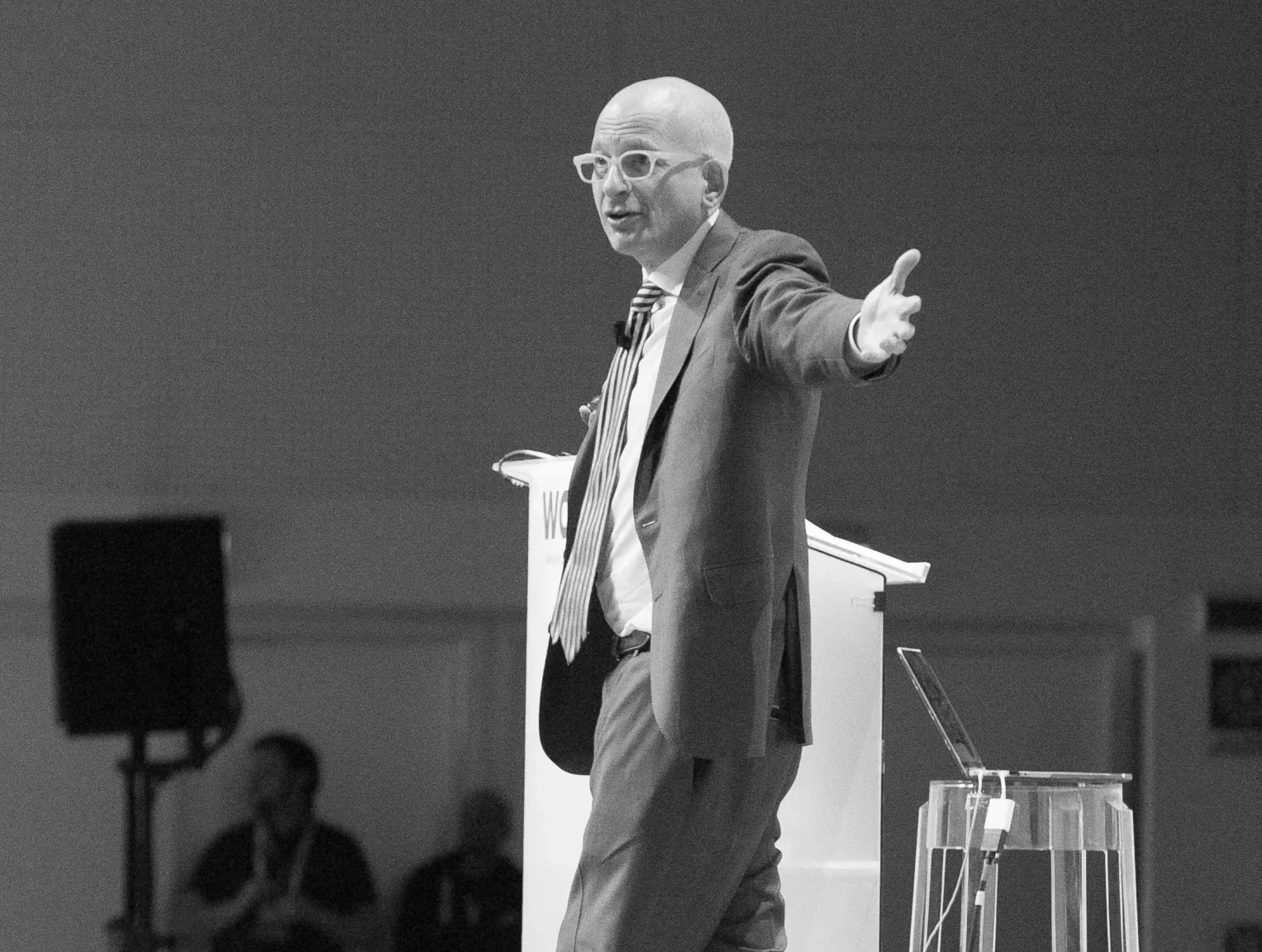
In this episode of the WOBI Podcast , Seth Godin offers a clear perspective for leaders seeking to move beyond reaction, designing organizations that can adapt, evolve, and endure.
Drawing from an exclusive conversation with WOBI at the World Business Forum New York 2025, Seth goes beyond theory to address key questions leaders are facing right now: how to build resilient organizations, how to navigate constant disruption, and how to create meaningful impact in a world that refuses to stand still. Seth returns this year at the World Business Forum in Sydney, to explore what it truly takes to lead in uncertain times.
Press play and start listening to this WOBI Podcast episode — Leading with Resilience — to learn how you can navigate change and build meaningful, long-term impact.
The Difference between Leadership & Management
In Seth’s view, leadership is not about telling people what to do. It’s about designing the conditions that allow people to move forward despite the ambiguity — shaping the system, the culture, and the environment in which progress becomes possible. Because uncertainty cannot be managed away, it can only be navigated.
As he explains:
“Leadership — which is not the same as management — is about creating the conditions for people to show up when we can help them get to where they want to go.”
It’s a subtle shift, but a decisive one. Management is rooted in control and efficiency, while leadership is about setting direction, shaping the environment, and enabling possibility.
Resilience: The Most Underrated Leadership Skill
In a constantly shifting environment, even the best strategies are bound to face disruption. For Seth, resilience is not just a personal trait, it’s a leadership capability.
“Resilience is a superpower… I’m going to show up in a way that no matter how the world changes, I’ll be glad I went down this path.”
He contrasts two mindsets:
Expecting the world to behave as planned
Adapting and moving forward regardless of change
At its core, resilience is a different way of engaging with uncertainty. It is the ability to withstand the impact, recover your footing, and transform through the challenge. It’s about moving forward regardless of how conditions evolve, staying committed to the path even when the ground beneath you is no longer stable. In other words: leadership today means adjusting, adapting, and evolving when the outcome is still unclear.
Seth captures this shift with a simple metaphor:
“I’m surfing, I’m not playing golf.”
Leaders today can’t control every variable, but they do need to learn how to move with the waves. However, mindset alone isn’t enough. Organizations also need the structures and cultures that allow people to adapt, experiment, and collaborate. And that can be especially challenging in large companies.
Why Most Organizations Struggle to Become Agile
While agility has become a common aspiration, few organizations truly achieve it. Seth Godin points to a deeper structural tension:
“Large organizations are built on an industrial assembly line mindset.”
Most companies were designed for stability — with fixed roles, predictable processes, and systems optimized for efficiency. That logic made sense in a more stable world, but it doesn’t hold in a constantly shifting one.
The challenge today remains not to “add agility” on top of existing structures, but to redesign systems from the ground up — accepting both the benefits and the trade-offs that come with it. Organizations that embrace this shift don’t just move faster, they operate differently. Agility is the ability to process signals—whether they come from a shifting market or from within the organization itself—and turn them into collective action. It looks like decentralized authority, where the people closest to the problem have the power to solve it. Implementing this means moving away from “command and control” toward “connect and collaborate”—prioritizing adaptable networks over rigid hierarchies.
Rewarding the Process, Not Just the Outcome
One of the biggest barriers to innovation is how organizations define success. In many companies, performance is measured almost exclusively by results, and that creates a predictable pattern: if what gets rewarded is certainty, the safest move is to repeat what worked before.
“Why would an employee be excited to innovate in an organization that only rewards results?”
Real innovation rarely looks efficient at the beginning: it’s uncertain, uneven, and often uncomfortable. It involves trying things that might not work — and sometimes, don’t.
For that to happen, leaders need to shift what they value. Not just outcomes, but the process behind them: the effort, the experimentation, the intent, and the willingness to explore new paths even without guarantees. Because innovation emerges when people are given the space — and the permission — to try.
AI, Creativity, and the Risk of “Scale Without Meaning”
As artificial intelligence becomes more accessible, the conversation in many organizations quickly turns to one idea: scale. More content, faster production, greater efficiency.
But Seth introduces a critical warning:
“Anytime you use the expression generative AI and at scale, you’re arguing for slop.”
In other words: producing more doesn’t necessarily mean creating value. In fact, it often does the opposite.
For Seth, the real opportunity of AI is not about doing things faster or cheaper, but about doing them better. He invites us to ask ourselves three key questions:
-
Can this improve the experience?
- Can this solve a meaningful problem?
- Can this create something new and valuable?
Which brings the conversation back to a fundamental question: who is it for, and what is it for? If everyone has access to the same tools to scale what is average, advantage no longer comes from producing more — it comes from producing what actually matters. AI is not the differentiator; how you use it is.
The real opportunity is simple: let the machine handle the average, so people can focus on what is exceptional. Without that clarity, scale doesn’t amplify impact — it amplifies irrelevance.
“If It Doesn’t Ship, It Doesn’t Count”
Ideas are everywhere. They show up in meetings, in conversations, in late-night notes that never quite make it past the draft stage. Organizations are full of them, but few ever make it into the world. That’s where Seth draws a clear line.
“If it doesn’t ship, it doesn’t count.”
It’s a simple idea, but an uncomfortable one, because it forces a shift from thinking to doing — from polishing ideas to putting them at risk.
No matter how innovative or ambitious an idea may be, it only creates value once it becomes real. And that requires something most organizations struggle with: the willingness to act before everything is perfect.
For leaders, this means:
- Prioritizing action over perfection
- Moving from concept to execution
- Accepting constraints as part of progress
Because in the end, strategy is not just what you plan, it’s what you deliver.
Strategy as the Architecture of Change
Most organizations approach strategy as an extension of what already works: refining, optimizing, and repeating. It feels safer that way. However, at the core of Seth Godin’s thinking, is a broader idea: in a world that is constantly shifting, repeating yesterday is rarely enough to build tomorrow.
For him, strategy is not a plan to protect what exists. It is a deliberate act of design — a way of shaping change rather than reacting to it. It means making conscious choices about:
- Where to focus
- What to stand for
- Who you are trying to serve
From this perspective, strategy stops being an exercise in analysis or prediction to become something more intentional: a process of creation. Creating not the largest possible audience, but the right one. Not short-term wins, but long-term relevance.
From NY to Sydney: Continuing the Conversation
When Seth Godin speaks about strategy, he rarely starts with markets, trends, or competition. He starts with a tension.
In a recent exclusive interview with CEO Magazine, he describes a pattern that sits at the heart of many organizations: the simultaneous desire to move forward and to stay safe. Companies want to innovate, but without risking what already works. They want to stand out, but without alienating anyone. They want to lead, but without exposing themselves to uncertainty.
For Seth, this is where strategy often breaks down. Not because leaders lack ideas, but because they try to resolve that tension through planning instead of choice. Strategy, in his view, is not about outlining a path that avoids risk — it is about deciding what matters, who it is for, and what you are willing to commit to, even when the outcome is not guaranteed.
Seth Godin will continue this conversation at the World Business Forum in Sydney, where he will explore how to confront the trade-offs behind every strategic decision. For organizations navigating constant change, it becomes an opportunity to rethink direction, sharpen decisions, and move forward with greater intention.
Listen to the Full Conversation on the WOBI Podcast
And if this is the kind of thinking that challenges how you lead, you can continue exploring more insights by becoming a WOBI Member — with on-demand access to hundreds of hours of content from global thinkers, designed for leaders who see continuous learning as a strategic advantage.